

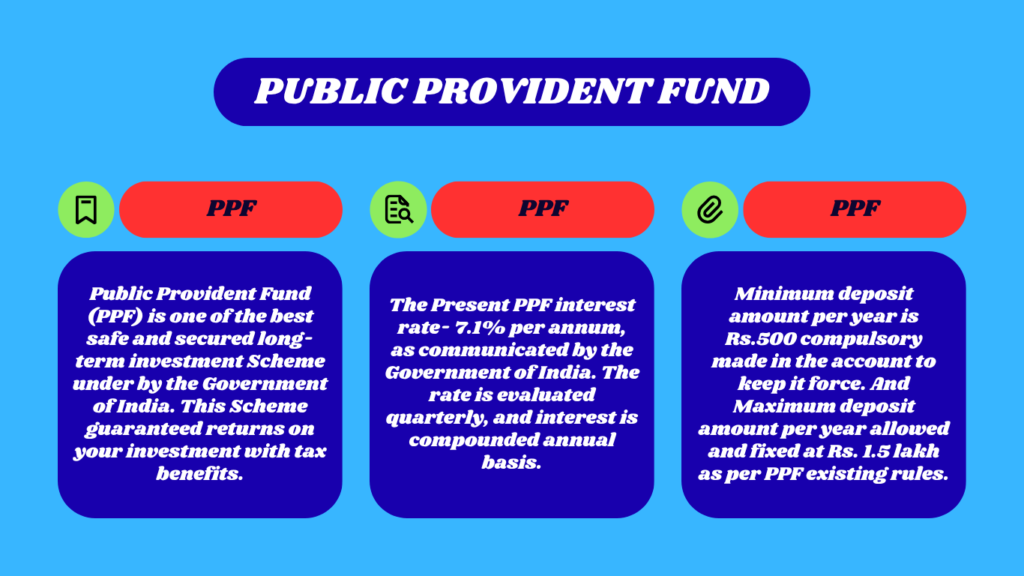
Public Provident Fund (PPF) is one of the best safe and secured long-term investment Scheme under by the Government of India. This Scheme guaranteed returns on your investment with tax benefits.
Public Provident Fund [PPF]
A Public Provident Fund account creates a disciplined savings habit while enjoying capital protection, long-term wealth generation. Here we will know how a PPF account works, the latest rules, required documents, eligibility, contribution limits, withdrawals, loans and other features you should know before enter into this scheme.

Eligibility to Open a new PPF Account
Any Indian resident individual is eligible to open a Public Provident Fund account and should fallow the specific rules & regulations specified by the government.
Eligibility Criteria
- The person should be an Indian resident and can open a PPF account in their own name.
- One person – 1 account allowed across all nationalised banks and post offices.
- In this PPF Scheme Joint accounts are not permitted.
- Associations Hindu Undivided Families, trusts, and groups are not eligible to open a PPF account.
Non-Resident Indian cannot open a new PPF account, but accounts opened before becoming NRI can continue till maturity. However, it cannot be further extended. Extension allowed only for Indian residents.
Latest Rules & Government Amendments about PPF Scheme
- The Present Public Provident Fund interest rate- 7.1% per annum, as communicated by the Government of India. The rate is evaluated quarterly, and interest is compounded annual basis.
- Interest is calculated on a monthly basis but credited to your bank account only once in a year, at the end of the financial year_i.e. 31-March.
- Calculation – Maturity period of a PPF account is calculated from the end of the financial year in which the first deposite is made, not from the PPF account opening date.
- After maturity date, Account can be extended in blocks of 5 years (5 years, 10 years, 15 years), either with fresh deposit or without deposits, each having different withdrawal terms and conditions.
- When the withdrawals exceeding Rs. 20 lakh, the TDS will be applicable. it will be applicable only if you have not filed an Income Tax Return in the past 3 years in new rule.
Required documents for opening a Public Provident Fund (PPF) account.
| S No | Document | Purposes |
| 1 | Aadhaar card | Identity Proof and KYC |
| 2 | PAN card | Mandatory for tax record and 80C |
| 3 | Recent Passport-size photograph | Account record |
| 4 | Form A (opening form) | Application |
| 5 | Nomination form 10 (Form E) | Nominee details |
Conditions of Public Provident Fund (PPF) Account for Minors
- Only Parent or legal guardian can open and operate a PPF account in a minor child’s name.
- Only one parent may open an account for a minor.
- An Adult and a minor can’t have joint account.
- The total annual contribution across the parents’ and minor’s PPF accounts cannot exceed Rs.1,50,000/-.
- Grandparents can open a Public Provident Fund account for a minor only if they become legal guardian after the parent demise.
- Know Your Customer (KYC) documents and a recent passport-sized photograph of the minor and the parent / guardian is required.
- Minor Birth Certificate or Aadhaar Card are necessary as proof of age.
- Once the process is complete, the Bank provides the Public Provident Fund Account details for account operation.
Minimum Contribution & Maximum Contribution
Minimum deposit amount per year is Rs.500 compulsory made in the account to keep it force. And Maximum deposit amount per year allowed and fixed at Rs. 1.5 lakh as per PPF existing rules.
Excess amount refunded to the subscriber without any interest, If annual PPF deposits exceed Rs. 1,50,000/-
PPF account opening procedure through online
If you want to open a Public Provident Fund account in online, your bank account must have a net banking facility. Below steps that you can follow to open a PPF account in online:
Method 1: YONO App
Stage 1. Open the “SBI YONO APP” and log in
Stage 2. Go to “Investments” →→→→→ “PPF Account”
Stage 3. Select “Open New PPF Account”
Stage 4. Enter nominee details (Full Name, relationship with Account holder, date of birth)
Stage 5. Choose your initial Contribution amount (Minimum Rs.500)
Stage 6. Verify details and confirm with OTP
Stage 7. Your PPF account is opened instantly
Stage 8. Note down the PPF account number displayed on screen (Ex. xxxxxxx6789)
Stage 9. You can view the account under the “PPF” section in YONO
Method 2: SBI Internet Banking (OnlineSBI)
Stage 1. Log in to WWW.OnlineSBI
Stage 2. Go to “Deposits & Investments” →→→→→ “PPF” →→→→ “Open a PPF Account”
Stage 3. Select the SBI branch where you want the account linked
Stage 4. Fill in personal details and nominee information
Stage 5. Enter the initial deposit amount (minimum ₹500)
Stage 6. Confirm, you will receive OTP and authenticate with OTP
Stage 7.PPF account is created and linked to your net banking
If you want your Public Provident Fund contribution automatically deducted from your account, then many banks allow you to give standing instructions. After validating your OTP authentication, your PPF account will be generated instantly, and you will receive your PPF account number. Also, you will receive confirmation for the same through the bank on your registered email ID.
PPF account opening procedure through offline
process to open a Public Provident Fund (PPF) account in a post office :
By visiting your nearest post office branch, You can open a PPF account in offline.
Follow the steps below to open a PPF account via a post office:
Stage 1: Collect the PPF account opening form from your nearest post office branch.
Stage 2: Fill out with the required details such as your name, address, PAN number, and nominee details.
Stage 3: Pay the first deposit, any amount between Rs. 500 and Rs .1,50,000[Multiple of Rs.50/-]
Stage 4: Submit the form along with xerox copies of required KYC documents like Aadhaar card, PAN card, and address proof.
After submitting that, the post office official will process your application and issue a passbook as confirmation of your PPF account.

Penalty
Penalty – Rs.50 per year
If subscriber break the minimum deposite of Rs. 500 in a financial year,the PPF account will become inactive. After this inactive PPF account can be activated by paying a penalty amount of Rs. 50 for each year. (inactivity period). This amount addition to the Rs.500/- minimum deposite required for each year the account was inactive.
Inactive Public Provident Fund (PPF) account _ Activation Procedure
In this case, you can’t deposit money or withdrawals. Now, you can easily reactivate your PPF account by following below steps:
Step 1: Submit the application for reactivation of your PPF account and submit it to the concerned bank branch.
Step 2: Deposit the minimum contribution of Rs.500/- for each financial year during which the account left over inactive.
Step 3: Pay a penalty of Rs.50/- for each financial year. (account inactive period)
For Ex: if you did not invest in your PPF account from FY 2024-25 to FY 2025-2026 (two financial years), you must deposit Rs 1,000 [Rs.500 × 2] as the minimum contribution and Rs. 100/- (Rs.50/- × 2) as penalty. Now, you need to pay a total of Rs.1,100/- for reactivation of PPF account.
How to transfer a PPF account from one branch to another?
You can transfer your Public Provident Fund account from your existing bank or post office branch to another branch or bank. Follow the step-by-step process below to transfer your PPF account:
Stage 1: You should go your existing branch where your PPF account is maintained and collect the PPF transfer form.
Stage 2: Fill out the transfer form and clearly mention the name and address of the branch where you want to transfer your PPF account and submit.
Stage 3: The branch will process your Public Provident Fund transfer request.
Stage 4: Your existing branch will send the required documents to the new branch. i.e. Original Account Opening Form, certified copy of the PPF account, nomination form, existing PPF passbook or consolidated PPF statement, cheque or demand draft of the outstanding balance, and specimen signature and etc.
Stage 5: Then, Visit the new branch, fill out a fresh account opening form, and submit the required KYC documents.
After you submit the form and documents, the new branch will process your request and issue a new PPF passbook.
Crucial Points to Remember for transfer a PPF account
- The Transferring branch & Receiving branch must be Authorised PPF offices
[all branches are Not Eligible] check the updated RBI / D O P list.
- At the new branch KYC re-verification is mandatory, so bring updated documents.
- You must complete nominee change if beneficiary details need updating.
- Maintain a copy of your old passbook for record of previous transactions.
What is the Best Time to Invest in PPF Scheme?
The best time to invest in Public Provident Fund Scheme is before the 5th of every month. Public Provident Fund PPF Scheme interest is calculated based on the lowest balance between the 5th and the last day of the month. If you want to get maximum interest, deposits should be made before the 5th of every month.
Lump Sum Investment vs Monthly Investment
- If you make a lump-sum investment, you must invest before the 5th of April to receive interest for the entire year.
- If you make a monthly investment, you must make it before the 5th of every month.
How to Check PPF Account Balance Online?
You should log in to your bank’s net banking or mobile banking application, navigate to the PPF accounts section and select your Public Provident Fund account to view the current balance, transaction history, interest details and etc. In post office, you can check the balance online through the India Post Payments Bank (IPPB).
How to Calculate PPF Interest & Maturity?
PPF interest is calculated monthly basis & credited to your account at the end of the financial year [31st March]. The maturity amount of a Public Provident Fund account depends on the annual deposit, the applicable interest rate, and the investment period, with returns compounding over time.
If you invest the maximum amount per year i.e.Rs.1,50,000/- every year in your PPF account at the start of each financial year [i.e. from 1st April to 4th April], and the average interest rate remains around 7.1% per annum.
After 15 years, your total investment will be Rs 22,50,000/- (Rs 1.5 lakh x 15 years)
PPF maturity amount after 15 years would be Rs 40,68,000/- due to annual compounding of interest, Entire maturity amount, including the interest earned, is completely tax-free.

What are the Benefits and Limitations of a PPF Account?
Benefits
- Public Provident Fund is a government-guarantee scheme, so there is almost zero risk to capital.
- It provides guaranteed returns with long-term compounding benefits.
- Investments made in PPF are eligible for deduction under Section 80C up to Rs 1,50,000/-
- Interest earned and maturity proceeds are completely tax-free (EEE status).
- PPF Scheme is Suitable for long-term goals like children’s education or retirement.
Limitations
- This scheme is not suitable for Short-term goals, This Scheme 15-years lock-in period.
- Annual investment is Maximum fixed at Rs.1,50,000/-
- Partial withdrawals are restricted and subject to conditions.
How to Withdraw money from PPF?
- lock-in period is15 years, after which the subscriber can withdraw the entire balance.
- Partial withdrawals are allowed after 5 financial years, excluding the year of the first deposit. So withdrawal available from the 7th year onwards, calculated from the account opening date.
- You can withdraw only one time is permitted in a financial year.
- The maximum withdrawal allowed is 50% of the balance at the end of the previous financial year
(or)
50% of the balance at the end of the fourth financial year preceding the year of withdrawal, whichever is lower.
- After a partial withdrawal, you cannot opt for a loan against the PPF account.
- To withdraw money from a PPF account, Submit PPF Form C to the bank or post office.
- The above withdrawal rules apply to PPF accounts if it is not yet matured.
- If account is extended beyond maturity without additional deposit, the you can withdraw up to the total account balance, with only one withdrawal allowed per financial year.
- If account is extended after maturity with additional deposit, the maximum withdrawal allowed is 60% of the account balance at the start of the extension period.
Closure of Public Provident Fund Account
After maturity the subscriber can just submit an application to the bank or post office managing your PPF account.
But prematurely closing the account involves a few terms and conditions you should follow:
- Firstly, premature closure of account is allowed only after completion of at least 5 financial years. So, you can close a PPF account only after the start of the 7th year from the account’s opening date.
- Secondly, premature closure of account is allowed only under some specific conditions such as higher education, change in residency status, or to arrange funds for a serious illness.
- Additionally, the interest earned by the subscriber will be 1% lower than the actual interest rate that the subscriber would have received by continuing the account. While this 1% penalty may seem small, this lower interest rate applies from the account opening date.
Suppose a you have earned 7% interest on the PPF account for the past 10 years. If the account is closed prematurely, the interest earned will be recalculated at the reduced rate of 6%. This will reduce the returns obtained from the PPF account at the time of premature withdrawal day.
How to take Loan against PPF?
Maximum eligible PPF loan amount is 25% of the closing balance in the 2nd year preceding the Financial Year. Between the 3rd and 6th years of the account.
The interest rate applicable to 1% higher than the applicable PPF interest rate. Current interest rate of 7.1% p.a., the interest rate for a loan will be 8.1% p.a.
A loan tenure offered 36 months. If the outstanding loan amount is not repaid within this period, the interest rate of the loan is increased to 6% in addition to the PPF interest rate. So, a penal interest rate of 5% p.a. on the original loan interest rate is applicable if the loan is not paid off within 36 months.
Attachment of PPF Account for other Debt Repayments
The Balance of the PPF Account cannot be attached by a court order or decree in order to pay off any outstanding debts or liabilities of the subscriber. But while debtors can’t get access to a PPF account, this rule does not apply to Income Tax Department.
Important Note: The IT Department is legally allowed to use this PPF account balance towards the settlement of any tax-related orders issued to the PPF subscriber.
PPF account versus EPF: a common confusion
| EPF | PPF |
| EPF account is open to salaried employees | PPF account can open any resident individual |
| contributions from an employee and employer | contributions by account holder voluntarily |
| EPF’s rate is set annually by the EPFO | PPF interest rate is 7.F1 % |

FAQs
What is the best age to start a PPF investment?
There is no best age for starting an investment in PPF. However, the minimum age for starting investing in PPF is 18 years; hence, if you are 18 years or older, you can invest in the PPF.
Is PPF better than FD?
Public Provident Fund (PPF) is considered better than FD as it is an EEE (Exempt-Exempt-Exempt) category investment. That means investments made, interest earned, and maturity proceeds are totally tax-exempt.
However, unlike FDs, you cannot invest in PPF for a couple of years. So, it depends on your overall goal. for the long term, then PPF is good for you. And for short-term goals, then FDs are more suitable.
Is PPF better than LIC?
Both are help you earn tax-free returns and the returns are guaranteed. But, Public Provident Fund (PPF) gives you better returns than LIC policies. That said, if you have exhausted the Rs 1.5 lakh limit of PPF in a financial year and want to add more to your fixed-income portfolio, you can consider LIC policies.
For a life cover, it’s better to take for a term plan.
What will happen if I do not contribute to the PPF account in a financial year?
As per the PPF rule, it will become inactive if you have not contribute a minimum of Rs 500 per financial year.
Can I withdraw PPF before maturity?
Yes, you can withdraw PPF before maturity. But there are some terms & conditions must fulfil.
What is the penalty rule for Public Provident Fund (PPF) ?
your PPF account becomes inactive. In this scenario, you must pay a penalty of Rs.50/- for each financial year, inactive period. Apart from this, you will have to pay a contribution of Rs.500/- per financial year.